24/7 Emergency Smoke Damage Restoration in Freeport
24/7 emergency smoke damage restoration in Freeport and surrounding areas. Insurance billing accepted. Call (337) 344-1248.
Smoke damage emergency in Freeport? Call now. We answer 24/7 and send an OSHA trained crew to stop smoke residue from etching into surfaces while you’re still assessing what’s salvageable.
Smoke behaves differently than fire itself. Long after flames are out, soot particles keep working into drywall pores, grout lines, and HVAC ductwork, turning a contained kitchen fire into a whole-house odor problem within 24 to 48 hours if nobody intervenes. The smell that lingers isn’t sitting on the surface, it’s bonded to porous materials at a chemical level, which is why scrubbing with household cleaners often spreads residue instead of removing it.
What smoke damage restoration actually involves
Smoke damage restoration is the process of identifying what type of soot a fire left behind, removing it from every surface it reached (not just the visibly charred ones), and neutralizing odor at the molecular level rather than masking it. The work covers structural surfaces, HVAC systems, and contents, and the timeline depends heavily on how much the fire burned (wood, plastics, synthetics) and how far smoke traveled through the home’s air pathways before it was contained.
Protein-based soot, from a stovetop or grease fire, is nearly invisible but carries an intense, greasy odor that clings to cabinetry and fabric. Synthetic soot, from burning plastics, foam, or electronics, leaves a thicker, oily black film that smears if wiped incorrectly and tends to travel further through the HVAC system. Wildfire smoke cleanup, which shows up in the Panhandle during dry-season brush fires, behaves more like a fine, dry ash that settles into attic spaces and exterior cladding even when the structure itself was never directly exposed to flame.
Our process
- Soot characterization. We identify whether residue is protein-based, synthetic, natural (wood/paper), or wildfire ash, because each type requires a different cleaning agent and approach to avoid smearing or re-depositing residue.
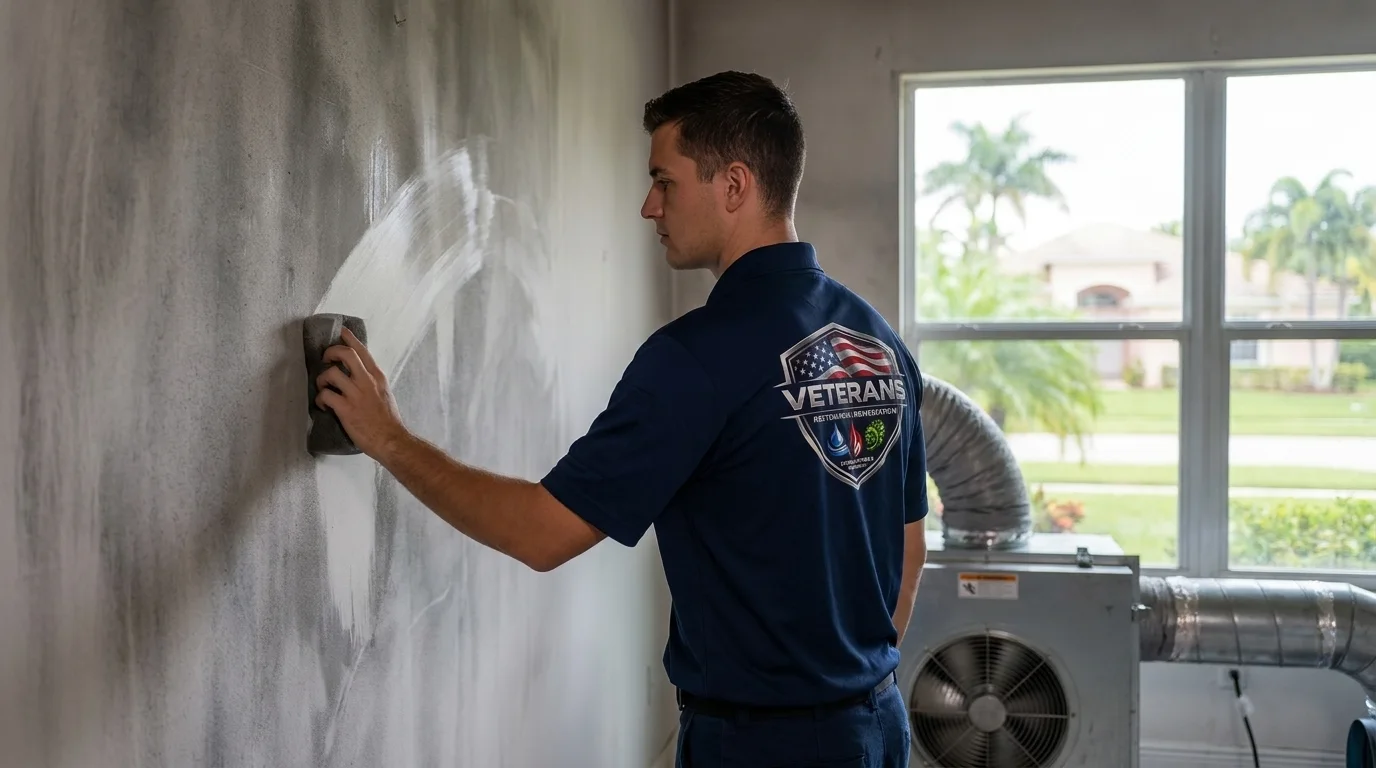
- Pre-cleaning and dry sponge removal. Dry chemical sponges lift loose soot from walls, ceilings, and trim before any wet cleaning begins, since introducing moisture too early can set residue permanently into porous materials.
- Wet cleaning and surface treatment. Washable surfaces, hard flooring, and non-porous materials get treated with solvents matched to the soot type, followed by sealing on surfaces that absorbed odor beyond surface cleaning.
- Odor neutralization. Thermal fogging or ozone treatment reaches into the same pathways smoke traveled, breaking down odor compounds in wall cavities, ductwork, and fabric rather than covering the smell with fragrance.
- HVAC and contents review. Ductwork gets inspected and cleaned if smoke recirculated through the system, and salvageable contents are cleaned, deodorized, or flagged for pack-out depending on how deeply residue penetrated.
What separates a good smoke damage response from a bad one
The most common mistake is treating smoke damage restoration like a deep cleaning job instead of a chemistry problem. Wiping synthetic soot with an all-purpose cleaner smears it across drywall and upholstery, driving residue deeper instead of lifting it. Skipping HVAC inspection is another frequent miss. If the system ran during or after the fire, soot and odor compounds have likely circulated through every room the ductwork reaches, not just the room where the fire started.
Insurance adjusters generally look for documentation that goes beyond the visibly burned area, photos and notes on secondary smoke travel into closets, HVAC returns, and adjoining rooms, along with a record of which soot-removal method was used where. A written pre-work inspection that separates “clean and treat” materials from “replace” materials also matters, since it gives the adjuster a basis for the scope rather than a verbal estimate after the fact.
What does smoke damage restoration cost?
Costs vary widely depending on how far smoke traveled, what type of soot is involved, and whether HVAC or structural materials need replacement rather than cleaning. Every loss is different, which is why Veterans Remediation & Restoration provides a written scope before any work begins rather than a flat estimate over the phone. Homeowners insurance typically covers smoke damage restoration when the fire itself is a covered peril, though coverage for odor-only or secondary smoke damage can vary by policy.
| Scenario | Typical range |
|---|---|
| Single room, light surface soot | $500 - $1,800 |
| Whole-room deep clean with odor treatment | $1,800 - $4,500 |
| Multi-room smoke travel with HVAC cleaning | $4,000 - $9,000 |
| Whole-house odor neutralization (ozone/fogging) | $3,500 - $8,000 |
| Contents pack-out, cleaning, and storage | $2,000 - $6,000+ |
Seasonal & regional considerations
Freeport’s dry season brings an uptick in brush and wildfire activity across the Panhandle, and wildfire smoke cleanup calls tend to cluster during these stretches even for homes that were never near open flame. Florida’s humidity works against anyone trying to self-treat smoke odor, since moisture in the air reactivates odor compounds that haven’t been fully neutralized, which is part of why DIY deodorizing often fails within a week or two of warm, humid weather.
Service area
Veterans Remediation & Restoration provides smoke damage restoration services to Freeport and the surrounding Walton County area, including nearby communities along the Highway 331 and Highway 98 corridors.
If smoke has settled into your home’s walls, ductwork, or belongings, don’t wait for the odor to set deeper. Call Veterans Remediation & Restoration to begin smoke and soot removal with a written scope built around how your fire actually burned.
Frequently Asked Questions
Does homeowners insurance cover smoke damage restoration?
Why does my house still smell like smoke after I cleaned it myself?
What's the difference between protein soot and synthetic soot?
Do I need to clean my HVAC system after a fire?
How long does smoke damage restoration usually take?
Looking for the best smoke damage restoration company in Freeport?
Veterans Remediation & Restoration provides smoke damage restoration in Freeport, FL and the surrounding area, and has served local property owners since 2020. We answer calls 24/7 — call (337) 344-1248 for immediate help.
Need Smoke Damage Restoration now?
We respond 24/7 across Freeport and surrounding FL cities.
Related Coverage
- Our Restoration Services
- Contact Veterans Remediation & Restoration
- Restoration Services in Crestview
- Restoration Services in DeFuniak Springs
- Restoration Services in Destin
- Restoration Services in Ebro
- Restoration Services in Eglin AFB
- Restoration Services in Fort Walton Beach
- Restoration Services in Harold
- Restoration Services in Hurlburt Field
- Restoration Services in Laurel Hill
- Restoration Services in Miramar Beach
- Restoration Services in Navarre
- Restoration Services in Niceville
- The Fire Damage Restoration Process, Explained