TL;DR: Mold can begin growing on wet building materials within 24 to 48 hours of water damage. In Santa Rosa Beach and along the Gulf Coast, where indoor relative humidity regularly exceeds 70%, that window shrinks further. The only reliable way to stop mold after water damage is to dry the structure completely, fast, using professional-grade equipment. If your home or rental property took on water, you have less than two days before mold becomes a separate, more expensive problem.
Your floors are still wet, the drywall feels soft, and you’re wondering whether mold is already growing behind the walls. If the water intrusion happened within the last 48 hours, you may still be ahead of active mold colonization. But on the Gulf Coast, that margin is thin. Santa Rosa Beach sits in one of the most humid coastal corridors in the continental United States, and that ambient moisture is exactly what mold spores need to move from dormant to actively growing.
How Long Does It Take for Mold to Grow After Water Damage?
Mold typically begins growing on wet materials within 24 to 48 hours under normal indoor conditions. That timeline comes from the EPA’s guidance on mold and moisture, which recommends drying water-damaged areas within 24 to 48 hours to prevent mold growth. On the Florida Panhandle, where outdoor humidity is high from late spring through early fall and air conditioning systems cycle on and off, the effective window can be shorter because the ambient air slows evaporation from wet materials.
Mold spores are everywhere, indoors and outdoors. They are not the problem. The problem is moisture. When a wet surface stays wet, spores land, germinate, and begin producing hyphae (the thread-like root structures of mold colonies) within hours. Drywall paper, wood framing, carpet backing, and insulation are all favorable substrates. Once hyphae are established, visible surface mold typically appears within 3 to 7 days, but the colony is already active before you can see it.
The Gulf Coast factor is real. When outdoor relative humidity is 85% and the indoor air is only slightly drier, wet materials lose moisture to evaporation very slowly. Professional drying equipment, specifically low-grain refrigerant (LGR) dehumidifiers and high-velocity air movers, is designed to overcome exactly this condition. A box fan pointed at a wet floor does not.
What Are the Signs of Mold After a Leak or Water Damage?
Early mold after water damage often looks and smells different from the dramatic black patches most homeowners picture. Knowing what to look for in the first week can help you catch it before it spreads.
Musty odor without visible growth. Mold produces microbial volatile organic compounds (MVOCs) as it metabolizes. A musty or earthy smell in a water-damaged room, even with no visible discoloration, is a strong indicator that mold is already active inside a wall cavity, under flooring, or in insulation.
Discoloration on drywall or ceilings. Look for gray, green, brown, or black spotting. It may appear fuzzy or flat. White or pink staining on drywall can also be mold, not just a water stain.
Warping or bubbling surfaces. Drywall that bubbles, paint that peels, or wood flooring that cups or crowns is holding moisture. Where moisture stays, mold follows.
Condensation on windows or walls. In a Santa Rosa Beach home with compromised insulation after a leak, you may see condensation forming on interior surfaces. That surface moisture is a secondary mold risk separate from the original water event.
Physical symptoms. Occupants experiencing new respiratory irritation, eye irritation, or worsening allergy symptoms in a recently water-damaged space should treat that as a mold signal until proven otherwise.
For a deeper look at what hidden mold looks like before it becomes visible, see the post on 7 Signs You Have Hidden Mold.
Can You Stop Mold After Water Damage?
Yes, you can stop mold after water damage, but the strategy and the outcome depend heavily on how quickly drying begins and how thoroughly it is completed. Speed and completeness are the two variables that matter most.
If drying begins within 24 hours, and the structure is brought to dry standard (materials at or below their equilibrium moisture content, typically measured with a calibrated moisture meter), mold colonization can often be prevented entirely. The IICRC S500 Standard for Professional Water Damage Restoration defines the drying protocols and documentation requirements that professional crews follow to demonstrate a structure has been returned to a dry condition.
If drying is delayed or incomplete, mold remediation becomes a separate scope of work from water damage restoration. That means containment, removal of affected materials, HEPA vacuuming, antimicrobial treatment, and post-remediation verification testing. It is more expensive and more disruptive than getting the drying right the first time.
DIY drying limitations. Consumer dehumidifiers are rated for comfort, not structural drying. A typical big-box store dehumidifier removes 30 to 70 pints of water per day under ideal conditions. A single LGR dehumidifier used by professional crews removes 100 to 200 pints per day and operates efficiently even at high ambient humidity levels. The difference matters in a Gulf Coast summer.
If water has been present for more than 48 hours, or if you are seeing any of the signs above, the practical question shifts from “can we prevent mold” to “how much mold is already there and what does remediation require.” A professional moisture assessment with thermal imaging and calibrated meters can answer that before any work begins.
What Does Water Damage Mold Remediation Actually Involve?
Water damage mold remediation follows a defined process when both problems are present. Understanding the steps helps you ask the right questions and evaluate any scope of work you receive.
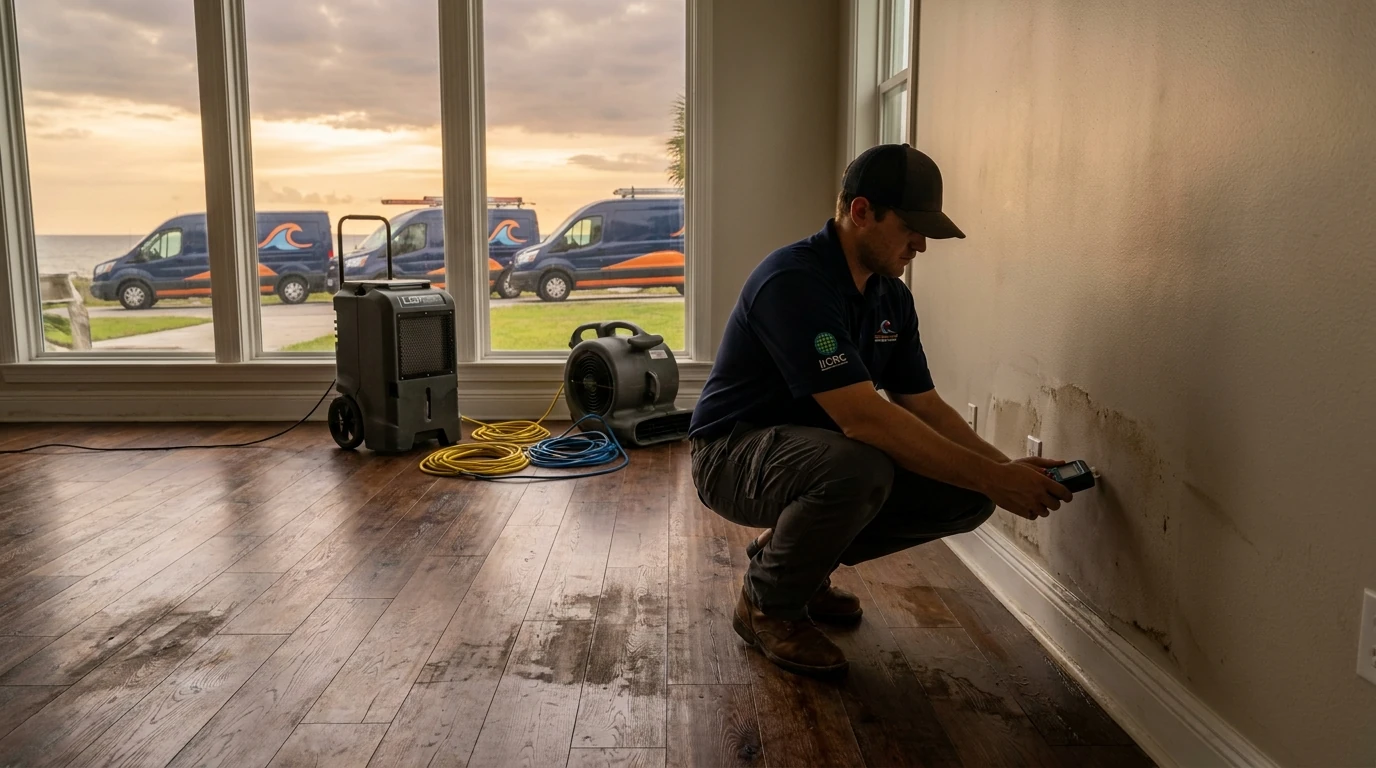
1. Moisture mapping and assessment. Before any demolition, a technician documents moisture readings across all affected materials using pin-type and pinless meters, and often thermal imaging to locate moisture behind finished surfaces. This establishes the full scope and creates the baseline for post-remediation verification.
2. Containment. Affected areas are isolated with poly sheeting and negative air pressure to prevent mold spores from spreading to unaffected parts of the structure during work. This is standard protocol under the IICRC S520 Standard for Professional Mold Remediation.
3. Removal of unsalvageable materials. Drywall, insulation, carpet, and other porous materials with active mold growth are removed and bagged for disposal. The cut line is typically extended 12 to 24 inches beyond visible mold growth to account for hyphae that have penetrated the substrate.
4. HEPA vacuuming and cleaning. Structural framing and hard surfaces are HEPA vacuumed, then cleaned with an EPA-registered antimicrobial solution. HEPA filtration captures particles down to 0.3 microns, which includes mold spores.
5. Drying the structure. If the water damage drying phase was not completed before mold work began, it runs concurrently or immediately after demolition. The structure must reach dry standard before any reconstruction.
6. Post-remediation verification. A clearance inspection, often including air sampling, confirms that spore counts in the remediated area are at or below outdoor baseline levels. This is the documentation your insurance adjuster and future buyer will want.
7. Reconstruction. New drywall, insulation, and finishes are installed after clearance. For water damage restoration that transitions into mold work, a single contractor handling both phases reduces coordination gaps and documentation errors.
If you are in Santa Rosa Beach or the surrounding area and need a mold remediation assessment, the scope of work should always start with a written moisture map, not a verbal estimate.
What Should You Do Right Now?
If water damage happened within the last 24 hours, start here:
- Stop the water source if it is still active. A plumber for a broken supply line, a roofer for storm intrusion, or your water shutoff for an appliance failure.
- Remove standing water immediately. Wet-dry vacuums work for small amounts; extraction equipment is needed for anything more than a surface spill.
- Move wet contents (furniture, rugs, boxes) out of the affected area if you can do so safely.
- Open interior doors to improve air circulation, but do NOT open windows if outdoor humidity is high. In a Santa Rosa Beach September, outdoor air is often more humid than conditioned indoor air, and introducing it slows drying.
- Call a water damage restoration professional. The 24-to-48-hour window is not a comfortable cushion. It is the outer limit.
If water damage happened more than 48 hours ago, or if you are seeing musty odors, discoloration, or physical symptoms, treat this as a mold situation from the start. The mold remediation process begins with an assessment, not a guess.
Veterans Remediation & Restoration responds 24/7 to water damage and mold calls across Santa Rosa Beach, Miramar Beach, and the surrounding Gulf Coast communities. Their OSHA-trained crew handles both water damage restoration and mold remediation, which matters when both problems are present at the same time. To schedule a moisture assessment or get a written scope, call (337) 344-1248.
About Veterans Remediation & Restoration
Veterans Remediation & Restoration is a veteran-owned, locally operated restoration company serving Santa Rosa Beach, Freeport, Destin, and the surrounding Florida Panhandle since 2020. The company is licensed, insured, and OSHA trained, handling water damage restoration, mold remediation, fire damage restoration, storm damage restoration, and water cleanup for residential and commercial properties. They operate 24/7 and provide written scopes before work begins.